Monday, 1 March 2010

崑曲之桃花扇與牡丹亭:Kunqu-Peach Blossom Fan & Peony Pavilion


I have always been in love with Chinese opera, in particular kunqu (崑曲). The sweetness and tenderness of the actors’ voice, delicate hand gestures, dramatic facial expressions (especially those of the eyes), beautifully abstract movements, gorgeous costumes and classical stage designs etc. are but a few reasons that started my fascination with this enchanting and refined ancient artform. There has been a renaissance of kunqu opera in recent years, with artists from many different genres, writers, scholars and dramatists contributing their expertise into revitalising the art of classical Chinese theatre. Kunqu was listed as one of the Masterpieces of the Oral and Intangible Heritage of Humanity by UNESCO in 2001. Its melody or tune is one of the Four Great Characteristic Melodies in Chinese opera.

David and I went to see “The Peach Blossom Fan” at the Esplanade Theatre on Friday evening, performed by Jiangsu Kunqu Opera Theatre of China. It was an exquisite and dazzling performance, which I thoroughly enjoyed (equally as I adore the famous “Peony Pavilion” I saw in Taipei and London previously)—such a magnificent and harmonious marriage of music, theatre, songs, choreographed martial arts, dance, beautiful costumes, set designs, and splendid poetry/literature. “The Peach Blossom Fan” is a profoundly stunning, mesmerising dramatic piece with an Advaita Vedantic or Taoist, highly philosophical ending.


孔尚任《桃花扇》:Peach Blossom Fan by Kong Shangren


The Peach Blossom Fan is the landmark of the Chinese ancient legends. Tian Qinxin, Director of the Kunqu Opera—The Peach Blossom Fan (1699)—has invited the world-renowned artists to present an immortal masterpiece that will be passed from generation to generation.

The stage design for the play highlights simplicity and smart space: the stage contains smaller stages, the cloisters on both sides are painted with the painting works of the Ming Dynasty—The Map of the Prosperous Southern Capital—a masterpiece comparable to Life along the Bian River at the Pure Brightness Festival, and the mirror floor clearly reflects the human figures to render the effect of the shining waves.

The stage will also present rare treasures: Almost 200 sets of performing costumes that are all manually embroidered; the music score that will be sung again by the people today; the fan inscribed by Yu Zhenfei, the Kunqu Opera master; the headwear passed down from the ancestors of the famous masters, and the Ming Dynasty furniture.

Shi Xiaomei, Hu Jinfang, Huang Xiaowu and Ke Jun, known as four “
Plum Blossoms,” will show up on the same stage to give a classical performance by three generations of Kunqu Opera actors.


Synopsis:

Using a peach blossom fan as the plot, the play expresses the emotion of rise and fall through the emotion of departure and reunification by elaborately combining the love story between Hou Fangyu, a famous scholar of Fushe, and Li Xiangjun, a famous prostitute in the Qinhuai River Region, with the political decay of the Southern Ming Dynasty. The play invites deep thinking and review.

Hou Fangyu got to know Li Xiangjun in a Nanjing brothel, and got engaged with each other. Ruan Dacheng, a remnant of the eunuch party, sent trousseaux to Li Xiangjun in private to buy Hou Fangyu after knowing the hero was financially tight. Li Xiangjun saw through the plot of Ruan Dacheng, and insisted on returning the trousseaux. Later, Ruan Dacheng brought a false charge against Hou Fangyu, saying Hou was collaborating with Zuo Liangyu to betray the court, and Hou was forced to escape Nanjing.
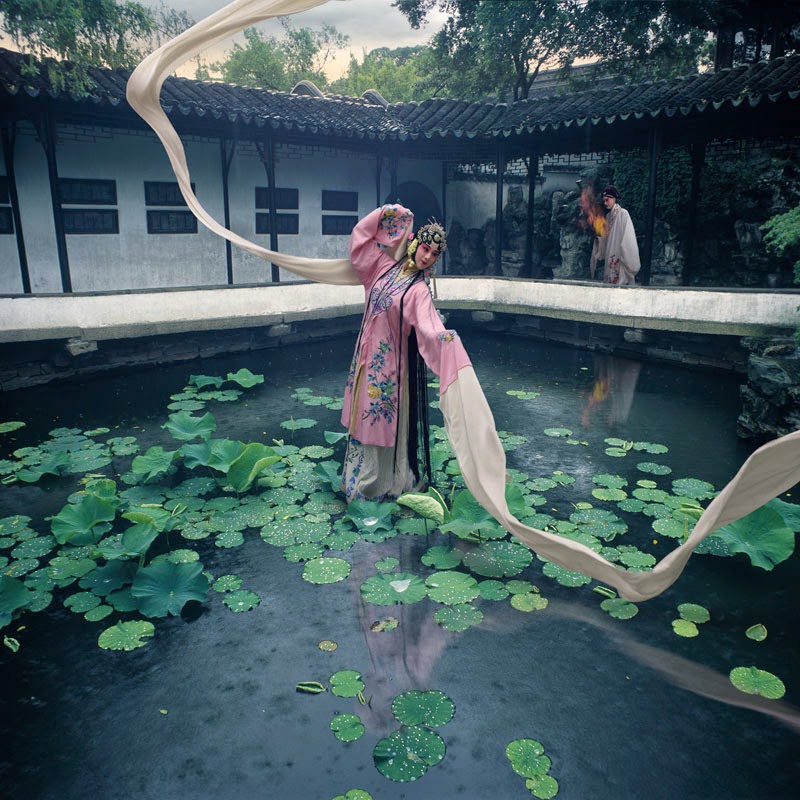

馮方宇《梅雨,踏荷》2007; 江蘇省蘇州崑劇院 *image via

After Chongzhen, the last emperor of the Ming Dynasty, hanged himself, Ma Shiying and Ruan Dacheng were in power again by supporting Prince Fu. They forced Li Xiangjun to diverse Hou Fangyu and marry Tian Yang, a follower. Li Xiangjun preferred to die rather than yield, and committed a suicide, with her blood sprayed on a fan, on which a love poem was inscribed. Yang Longyou, a friend of Hou and Li, painted the blood spots on the fan into peach blossoms on bent branches, and named it “The Peach Blossom Fan.”

The Qing troops marched southwards, defeated Shi Kefa, a general of the Southern Ming Dynasty, and overthrew the Southern Ming Dynasty.

Hou and Li met each other again after ups and downs. However, where would be their end after the country was destroyed.

A Taoist surnamed Zhang on the Qixia Mountain enlightened them, saying “
The Peach Blossom Fan was broken.” Then, Hou and Li then became the Taoist worshipers.

(*Via: National Centre for the Performing Arts, China.)


湯顯祖《牡丹亭》:Peony Pavilion by Tang Xianzu


The Peony Pavilion (simplified Chinese: 牡丹亭; traditional Chinese: 牡丹亭; pinyin: mǔdāntíng) is a play written by Tang Xianzu in the Ming Dynasty and first performed in 1598 at the Pavilion of Prince Teng. One of Tang’s “Four Dreams,” it has traditionally been performed as a Kunqu (昆曲/崑曲) opera, but Chuan (川) and Gan (赣/贛) opera versions also exist. It is by far the most popular play of the Ming Dynasty, and is the primary showcase of the guimendan (闺门旦/閨門旦) role type. All Kun theatre troupes include it in their repertoire. Recent adaptations have sought to inject new life into one of China’s best-loved classical operas, though such efforts have met with opposition from the Kun opera traditionalists.


Synopsis:

The performance tradition has focused on the love story between Du Liniang (杜丽娘/杜麗娘) and Liu Mengmei (柳梦梅/柳夢梅), but its original text (standard translation: Cyril Birch) also contains subplots pertaining to the falling Song Dynasty’s defense against the aggression of the Jin Dynasty.

It is the last days of the Southern Song Dynasty. On a fine Spring day, her maid persuades Du Liniang, the sixteen-year-old daughter of an important official, Du Bao, to abandon her studies and take a walk in the garden, where she falls asleep. In Du Liniang’s dream she encounters a young scholar, identified later in the play as Liu Mengmei, whom in real life she has never met. Liu’s bold advances starts off a flaming romance between the two and it flourishes rapidly. Du Liniang’
s dream is interrupted by a flower petal falling on her (according to her soliloquy recounting the incident in a later act: Reflection on the lost dream. However, she was apparently awoken by her mother according to the script itself). Du Liniang, however, is since preoccupied with the intense oneiric affair and her lovesickness quickly consumes her. Unable to recover from her fixation, Du Liniang wastes away and dies.

The president of the underworld adjudicates that a marriage between Du Liniang and Liu Mengmei is predestined and Du Liniang ought to return to the earthly world. Du Liniang appears to Liu Mengmei in his dreams who now inhabits the same garden where Du Liniang had her fatal dream. Once recognising that Du Bao’
s deceased daughter is the lady who appears in his dreams, Liu agrees to exhume her upon her request and Du Liniang is brought back to life. Liu visits Du Bao and informs him of his daughter’s newly resurrection. However, Liu is met with disbelief and imprisoned for being a grave robber and an impostor. The ending of the play follows the formula of many Chinese comedies. Liu Mengmei narrowly escapes death by torture thanks to the arrival of the results of the imperial examination in which Liu has topped the list. The emperor pardons all.

(This is only a broad outline of the plot of an opera which typically runs for 20 hours.)


About Kunqu:

Kunqu (崑曲; pinyin: Kūnqǔ; Wade-Giles: k’un-ch’ü), also known as Kunju, Kun opera or Kunqu Opera, is one of the oldest extant forms of Chinese opera. It evolved from the Kunshan melody, and dominated Chinese theatre from the 16th to the 18th centuries. Kunqu originated in the Wu cultural area.

Kunqu boasts a 600-year history and is known as the “teacher”
 or “mother” of a hundred operas, because of its influence on other Chinese theatre forms, including Jingju (Peking Opera). Its emergence ushered in the second Golden Era of Chinese drama, but by the early twentieth century it had nearly disappeared, which was only exacerbated by deliberate attempts to suppress it during the Cultural Revolution.

One of the major literary forms of the Ming and Qing dynasties was chuanqi drama, originating from the South. Chuanqi, an old form of dramatic opera, originates from the nanxi in late 14th century before the kunqu opera arises. However, in late 16 century, kunqu opera starts to dominate large part of Chinese drama. Plays that continue to be famous today, including The Peony Pavilion and The Peach Blossom Fan, were originally written for the Kunqu stage. In addition, many classical Chinese novels and stories, such as Romance of the Three Kingdoms, Water Margin and Journey to the West were adapted very early into dramatic pieces.

A Kunqu performer’
s portrayal of Hu SanniangToday, Kunqu is performed professionally in seven Mainland Chinese cities: Beijing (Northern Kunqu Theatre), Shanghai (Shanghai Kunqu Theatre), Suzhou (Suzhou Kunqu Theatre), Nanjing (Jiangsu Province Kunqu Theatre), Chenzhou (Hunan Kunqu Theatre), Yongjia County/Wenzhou (Yongjia Kunqu Theatre) and Hangzhou (Zhejiang Province Kunqu Theatre), as well as in Taipei. Non-professional opera societies are active in many other cities in China and abroad, and opera companies occasionally tour.

(*Via: wikipedia. Read more in-depth information about kunqu in “What is Kunqu Theatre?”)


Viennese Romance

I cannot stop reminiscing about Vienna and all of its beauty after watching the 2010 New Year's Concert video... For me, Vienna is like the jewel on an exquisite crown - perfectly elegant, and as the Chinese adage goes, "paints the eyes of the dragon."

I have combined these gorgeous short clips from Vienna's New Year Concerts with some lovely paintings which I find to be emanating the same fragrance and aura.


Franz Xavier Winterhalter, L'Impératrice Eugénie et ses dames de compagnies (The Empress Eugénie Surrounded by Her Ladies in Waiting), 1855, Château de Compiègne. Taking its inspiration from 18th-century bucolic scenes, this monumental composition sets the sovereign and her entourage against the backdrop of a shady clearing in a forest. However, the composition is very artificial and formal. The empress, slightly to the left of center, is encircled by and dominates the group. {via Wikipedia}

Franz Xavier Winterhalter, Elisabeth of Bavaria, Empress of Austria, with Diamond Stars on Her Hair, 1865, Hofburg, Vienna.

Gustav Klimt, Portrait of Mada Primavesi, 1912.


(*All paintings below by Edgar Degas)


Friday, 22 January 2010

To Sleep, Perchance to Dream

O, she doth teach the torches to burn bright!
It seems she hangs upon the cheek of night
Like a rich jewel in an Ethiope's ear;
Beauty too rich for use, for earth too dear!
So shows a snowy dove trooping with crows,
As yonder lady o'er her fellows shows.
The measure done, I'll watch her place of stand,
And, touching hers, make blessed my rude hand.
Did my heart love till now? forswear it, sight!
For I ne'er saw true beauty till this night.


~William Shakespeare, Romeo and Juliet: Act i, Scene v


Carlos Acosta and Tamara Rojo in the balcony pas de deux of Kenneth MacMillan's Romeo and Juliet, Royal Ballet, Covent Garden.


Sunday, 17 January 2010

Rose, O pure contradiction, delight in being no one's sleep under so many eyelids.


Details of Gian Lorenzo Bernini's Il ratto di Proserpina.


No one feels another's grief, no one understands another's joy. People imagine they can reach one another. In reality they only pass each other by. ~Franz Schubert


Details of Gian Lorenzo Bernini's Apollo and Daphne.
(Photo above via: flickr)


Details of Antonio Canova's Psyche Revived by Cupid's Kiss.


If there is any substitute for love, it is memory.
~Joseph Brodsky


"There was a time when I talked unwillingly of Schubert, whose name, I thought, should only be whispered at night to the trees and stars!" ~Robert Schumann, Neue Zeitschrift (1839)


Whilst thus I sing, I am a king,
Although a poor blind boy.
(Der Blinde Knabe)


Wednesday, 2 December 2009

Poetry (v)

Poetry

And it was at that age... Poetry arrived
in search of me. I don't know, I don't know where
it came from, from winter or a river.
I don't know how or when,
no, they were not voices, they were not
words, nor silence,
but from a street I was summoned,
from the branches of night,
abruptly from the others, among violent fires
or returning alone,
there I was without a face
and it touched me.

I did not know what to say, my mouth
had no way
with names,
my eyes were blind,
and something started in my soul,
fever or forgotten wings,
and I made my own way,
deciphering
that fire,

and I wrote the first faint line,
faint, without substance, pure
nonsense,
pure wisdom
of someone who knows nothing,
and suddenly I saw
the heavens
unfastened
and open,

planets,
palpitating plantations,
shadow perforated,
riddled
with arrows, fire and flowers,
the winding night, the universe.

And I, infinitesimal being,
drunk with the great starry
void,
likeness, image of
mystery,
felt myself a pure part
of the abyss,
I wheeled with the stars,
my heart broke loose on the wind.


~Pablo Neruda, translated by Alastair Reid


宋,黃庭堅,七言詩〈花氣薰人帖〉,台北故宮典藏。

*

Someone Digging in the Ground

An eye is meant to see things.
The soul is here for its own joy.
A head has one use: for loving a true love.
Legs: to run after.

Love is for vanishing into the sky. The mind,
for learning what men have done and tried to do.
Mysteries are not to be solved. The eye goes blind
when it only wants to see why.


A lover is always accused of something.
But when he finds his love, whatever was lost
in the looking comes back completely changed.

On the way to Mecca, many dangers: thieves,
the blowing sand, only camel's milk to drink.
Still each pilgrim kisses the black stone there
with pure longing, feeling in the surface
the taste of the lips he wants.

This talk is like stamping new coins. They pile up,
while the real work is done outside
by someone digging the ground.


~The Essential Rumi, translations by Coleman Barks with John Moyne

*

Have patience with everything unresolved in your heart and try to love the questions themselves, as if they were locked rooms or books written in a very foreign language. Don't search for the answers, which could not be given to you now, because you would not be able to live them. And the point is to live everything. Live the question now. Perhaps then, some day far in the future, you will gradually without even noticing it, live your way into the answer.

~Rainer Maria Rilke, Letters to A Young Poet, trans. by Stephen Mitchell

Wednesday, 25 November 2009

Silk and Steel

Will we ever again be blessed with a rhythmic gymnast who is as artistic, as graceful, and indeed, as beautiful as Maria Petrova? I do not claim to be knowledgeable in the field of rhythmic gymnastics, but Maria is the only one I have seen whom I consider to be an artist, and not just an athlete. Here I will quote Marc Haegeman's words in describing Bolshoi Ballet's Svetlana Zakharova {see here & here}, as I find them befitting Petrova and wonderfully germane: "...her technically radiant dancing has an ideal blend of steely brilliance and silken delivery." (Marc Haegeman in Dance Now, Spring 2008; on Le Corsaire, Bolshoi Tour in Paris, January 2008.)


When I was in junior high school (thirteen or so), I watched Maria's performance for the first time on television, which was her ball routine in the 1993 Malaga European Cup. The choreography, the music, her technically perfect execution, gorgeous artistic rendition, and even down to her choice of costumes etc., had me completely engrossed. I then started writing articles about her and carefully following all her competitions - in a word, I was rather obsessed.


The reason why I enjoy and use YouTube so much is because I can access numerous rare video clips of something I might otherwise never be able to find (or will definitely take me forever to locate), as well as the fact that I make lovely discoveries everyday. Below are Maria's performances of the ball routine in 1993, 1995, and 1996, the year in which she retired.


The beginning of the ball routine in this clip is cut, but you can see it in the second video clip. The performance I watched and was mesmerised by is the 1993 Alicante World Championship (first clip).


About Maria Petrova

Maria Petrova (Bulgarian: Мария Петрова) (born November 13, 1975 in Plovdiv, Bulgaria) is a Bulgarian rhythmic gymnast. She shares the world record for the most individual world all-around rhythmic gymnastics titles of all time and has never placed lower than seventh in any competition in her entire career.

Petrova began her training at the age of five at the Levski Club in Sofia, Bulgaria coached by Natalia Moravenova. In her first World Championship appearance in 1991, she came second in the team competition after a hoop drop. Petrova found herself in fifth at the Barcelona Olympics after a penalty of .20 was imposed due to the zipper on the back of her leotard that had broken during her hoop exercise. A few months later, Petrova took second place behind Oxana Kostina and ahead of Larissa Lukyanenko.

In 1993, Petrova performed with her Panovaesque ball to an Indian melody. She also competed in a ribbon exercise, and a small-toss filled clubs routine to Suzanne Vega's "Tom's Diner". Her final performance to Carmina Burana caused a great crowd ovation. She went on to win the all-around, as well as three more gold medals (ball, hoop, ribbon) and a bronze medal (clubs).

She went on to win one more European title and two more world titles (shared in 1995 with Yekaterina Serebrianskaya), tying her with countrywoman Maria Guigova for the most wins in the latter category. Although she had tried to retire several times after her first World title, Petrova continued competing as a favor to the Bulgarian national team, which was in a rebuilding phase after the Eastern European Communist collapse.

Petrova shares the world record for most individual world all-around rhythmic gymnastics titles with Maria Gigova. Petrova's three titles were earned in 1993, 1994, and 1995 (shared).

In 1998 Petrova married Bulgarian footballer Borislav Mikhailov. She is currently a judge in rhythmic gymnastics.

(Via:
Wikipedia)

Sunday, 22 November 2009

You leave the same impression of something beautiful, but annihilating


If the moon smiled, she would resemble you.
You leave the same impression
Of something beautiful, but annihilating.
Both of you are great light borrowers.
Her O-mouth grieves at the world; yours is unaffected,
And your first gift is making stone out of everything.
I wake to a mausoleum; you are here,
Ticking your fingers on the marble table, looking for cigarettes,
Spiteful as a woman, but not so nervous,
And dying to say something unanswerable.

The moon, too, abases her subjects
But in the daytime she is ridiculous.
Your dissatisfactions, on the other hand,
Arrive through the mailslot with loving regularity,
White and blank, expansive as carbon monoxide.

No day is safe from news of you,
Walking about in Africa maybe, but thinking of me.


~The Rival, by Sylvia Plath


Solarised portrait by Man Ray (c. 1930), photo via John @ verdoux.

Lee Miller, by Man Ray (c. 1930), photo via John @ verdoux.


From one of my favourite films, The Saddest Music in the World.

Thursday, 19 November 2009

Christian de Laubadère


The short Miami jaunt this past weekend saw my encounter with artist Christian de Laubadère's exquisite series of works The Necks—paintings that are filled with delicate, feminine regalness and sensual sophistication—displayed at the Setai Hotel. It was an instant love affair which has left me entranced and besotted still now. The neck (in particular the nape), along with hands, are what I consider to be the most beautiful, narrative and poetic parts of a woman's body. Christian de Laubadère combines the nape with intricately detailed depictions of different hairstyles through Chinese history (especially those of the Tang and Qing dynasties), and a subtle hint of colours in vintage embroidered/printed fabrics or lace which he sources from China as well as France, to evoke a sense of faded, ethereal, mysterious grandeur, hearkening back to a poetical world of nostalgia.

The Necks 2003-2006
The Necks 2007-2008

Christian de Laubadère exhibition at the Stephanie Hoppen Gallery, London.


(Above two) Christian de Laubadère's paintings as displayed at Hotel Setai, Miami.


About the Artist (text taken from his official website)

Christian de Laubadère began living and working in Shanghai in 2001.

The series of 137 paintings displayed in the Hotel Setai (Miami) and the most recent 21 paintings shown in Shanghai are a reflection of Christian's fascination with the sophistication and sensuality of women, past and present. He paints on paper and canvas using lead pencils, smoke and charcoal as well as printed and embroidered fabric selected from China and France.

His signature in Chinese characters is "Lu" (麓 foot of the mountain) and "Mi" (冪 power) directly translated from a nickname of his childhood "Loumi" which means "my favourite one" in French dialect from Gascogne province.


無題


The world is a tragedy to those who feel, but a comedy to those who think. ~Horace Walpole (24 September 1717 – 2 March 1797)


Danse Serpentine (c.1896), Loïe Fuller


Loïe Fuller (1902), portrait by Frederick Glasier

Wednesday, 11 November 2009

Pina 碧娜


“Beauty captivates the flesh in order to obtain permission to pass right to the soul.” ~Simone Weil


Now from his breast into his eyes the ache
of longing mounted, and he wept at last,
his dear wife, clear and faithful, in his arms,
longed for as the sunwarmed earth is longed for by a swimmer
spent in rough water where his ship went down
under Poseidon's blows, gale winds and tons of sea.

Few men can keep alive through a big surf
to crawl, clotted with brine, on kindly beaches
in joy, in joy, knowing the abyss behind:
and so she too rejoiced, her gaze upon her husband,
her white arms round him pressed as though forever.


~The Odyssey by Homer (Translated by Robert Fitzgerald)


Pina Bausch by Walter Vogel, 1967
Philippine “Pina” Bausch (July 27, 1940 – June 30, 2009), 
photographed in Café Müller.

Der Abschied (we miss you...)


The sun departs behind the mountain
In all the valleys, evening descends
With its cooling shadows
O look! Like a silver boat
The moon floats on the blue sky-lake above
I feel the fine wind wafting behind the dark spruce
The brook sings loudly through the darkness
The flowers stand out palely in the twilight
The earth breathes, full of peace and sleep
And all yearning wishes to dream now
Weary men go home
To learn in sleep forgotten happiness and youth
The birds crouch silently in their branches
The world is asleep


It blows coolly in the shadows of my spruce
I stand here and wait for my friend
I wait to bid him a last farewell
I yearn, my friend, at your side
To enjoy the beauty of this evening
Where do you tarry? You leave me alone for so long!
I wander up and down with my lute
On paths swelling with soft grass
O beauty! O eternal love!
Eternal, love-intoxicated world!


夕陽度西嶺  群壑倏已暝  松月生涼夜  風泉滿清聽
僬人歸欲監  煙鳥棲初定  之子期宿來  孤琴候蘿徑


At Parting

The drink of parting
He asked him where he would go, and also why it must be
He spoke, his voice was choked
My friend, on this earth, fortune has not been kind to me!
Where do I go? I will go wander in the mountains
I seek peace for my lonely heart


下馬飲君酒  問君何所之  君言不得意  歸臥南山陲  但去莫復問  候雲無盡時


The Song of the Earth, choreographed by Kenneth MacMillan and set to Gustav Mahler's music, is amongst my most beloved ballets. The Farewell (Der Abschied), final movement of the music Das Lied von der Erde, is based on two Chinese poems written in the Tang Dynasty:
1. “At the Mountain-lodge of the Buddhist Priest Ye Waiting in Vain for My Friend Ding” by Meng Haoran
2. “At Parting” by Wang Wei
The poems were first translated into French, and were edited by Hans Bethge (in German) thereafter. The German version was then adapted by Gustav Mahler when he composed the final movement of Das Lied von der Erde in 1908.

Former Royal Ballet Prima Ballerina Darcey Bussell chose this piece as her swansong, her farewell to a dazzling career in the ballet world (she was Principal of the Royal Ballet since age 18). As Judith Mackrell wrote, "It was such an eloquent statement of the fact that dance's power lies so uniquely in the physical present, its beauties impossible to preserve because they rest on what is most vulnerable and perishable - the human body. Bussell knew that her own body was on the cusp of its powers. And she decided to leave before its decline was evident to anyone else."
(*From - Darcey: We miss you already)


17th May 1966: Anthony Dowell and Marcia Haydee in the ballet, 'Song of the Earth'. Music by Gustave Mahler, choreography by Kenneth MacMillan. (Photo by Erich Auerbach/Getty Images)

Rehearsal footage of Darcey's final performance (see also here - Song of the Earth: Introduction and Rehearsals)


My favourite scene from The Sleeping Beauty...

And, one of the Balanchine pieces very dear to my heart...

Monday, 9 November 2009

A Million Kisses to My Skin


David and I went out this evening for a very lovely dinner date at the wonderful French restaurant/bistro Le Boudin Blanc. We had beautiful food including a divine chestnut crème gateau with spices and dark chocolate sorbet (my obsession with Indian chai these days has given me a penchant for everything exotically fragranced). In a way the ambiance in this little gem of a restaurant neatly tucked away on a cobble-stoned alley felt even a teeny bit more French than being in Paris (ah, the blasphemy!)...

On our drive back home Bach's Piano Concerto No. 1 in D Minor was playing on the radio. I instantly turned up the volume as I've loved this gorgeous piece ever since I first heard it, and even more so after seeing David Dawson's ballet "A Million Kisses to My Skin" which he created for Dutch National Ballet in 2000. I went to the performance when Dutch National Ballet toured Sadler's Wells in London. The precision and athleticism does not wane its artistic and emotional quality in anyway, as far as I am concerned. Instead, I find a beautiful parallell between the dancer's movements and what attracts me so much to Bach's music (as well as numerous contemporary choreographers/musicians/composers). An emotional complexity and profundity achieved not through the least bit of sentimentalism, but via a channel that is controlled, balanced, subtle/implicit, at times intellectually challenging, or even 'digital' and rigid. Yet this communicative channel delivers something that is infinitely timeless, glowing intrinsically with qualities that are transcendent. How Bach's music moves me.

David mentioned one of his favourite books dealing with a similar subject, which he thinks I will love - Gödel, Escher, Bach: An Eternal Golden Braid, a Pulitzer Prize-winning book described as "a metaphorical fugue on minds and machines in the spirit of Lewis Carroll." It is to be included in my ever growing book list, and I am not a fast reader at all!

As Random Dance Artistic Director and Royal Ballet Resident Choreographer Wayne McGregor eloquently puts it, “I think there’s something wonderful about these dancers, how they’re able to take dislocating, disorienting physical language and imbue it with emotional resonance. I’m a great believer, as was Merce Cunningham, in that the human body can never be without meaning, that the body can never be abstract. The body is inherently literal.”

*Since embedding is disabled, please click here to watch the first movement of David Dawson's A Million Kisses to My Skin, performed by Dresden Semperoper Ballett in 2008, starring Natalia Sologub, Jiri Bubenicek, Olga Melnikova, Maximilian Genow, Elena Vostrotina, Claudio Cangialosi, Julia Carnicer, Giselle Doepker and Arika Togawa. Also visit the gallery for some excellent photographs of this ballet.


Glenn Gould plays Bach Piano Concerto No. 1 in D minor, BWV 1052

Sunday, 8 November 2009

愛染

愛染明王 (Aizen Myou-ou, Rāgarāja)


In Vajrayana Buddhism and in the esoteric Tendai and Shingon sects of Japanese Buddhism, Rāgarāja (Aizen Myō-ō, 愛染明王 or 愛染妙王) is the deity which transforms worldly lust into spiritual awakening. Originally a Hindu deity, Rāgarāja, the deity was adapted into Chinese Buddhism as Àiren Ming-wang, and then as Aizen Myō-ō when the founder of Shingon, Kobo Daishi returned from China to Japan.


Rāgarāja is considered a Vidyaraja or "Great Wisdom King", in keeping with others like Acala and Gozanze. There are four different mandalas associated with Rāgarāja. The first posits him with thirty-seven assistant devas, the second with seventeen. The other two are special arrangements, one made by Chisho Daishi, fourth patriarch of the Tendai sect, the other a Shiki mandala which represents deities using their mantra seed syllables drawn in bonji.

He is portrayed as a red-skinned, frowning man, his appearance representing suppressed lust and passion. He variously has two, four or six arms; in the latter form, his hands bear a bell, a stick, a thunderbolt, a lotus, a bow and an arrow. Similarly, he sometimes has two heads, with a lion's head in his wild hair. According to the Yogin Sutra (Ch: Jingangfeng louge yiqie yujia yuqi jing) attributed to Vajrabodhi, he represents the state at which sexual excitement or agitation becomes enlightenment and passionate love becomes compassion for all living things.

(*Text via: Wikipedia)

Poetry (iv)


...I could not
Speak, and my eyes failed, I was neither
Living nor dead, and I knew nothing,
Looking into the heart of light, the silence.


~T. S. Eliot, The Waste Land, 1922.

*

On the Nature of Daylight, from the album "The Blue Notebooks," composed by Max Richter.


Also watch David Dawson's ballet set to Richter's hauntingly beautiful score.
Related Posts Plugin for WordPress, Blogger...