


Tuesday, 2 June 2015
I cannot paint what then I was. The sounding cataract haunted me like a passion.
Five years have past; five summers, with the length
Of five long winters! and again I hear
These waters, rolling from their mountain-springs
With a soft inland murmur.—Once again
Do I behold these steep and lofty cliffs,
That on a wild secluded scene impress
Thoughts of more deep seclusion; and connect
The landscape with the quiet of the sky.
The day is come when I again repose
Here, under this dark sycamore, and view
These plots of cottage-ground, these orchard-tufts,
Which at this season, with their unripe fruits,
Are clad in one green hue, and lose themselves
‘Mid groves and copses. Once again I see
These hedge-rows, hardly hedge-rows, little lines
Of sportive wood run wild: these pastoral farms,
Green to the very door; and wreaths of smoke
Sent up, in silence, from among the trees!
With some uncertain notice, as might seem
Of vagrant dwellers in the houseless woods,
Or of some Hermit’s cave, where by his fire
The Hermit sits alone.
These beauteous forms,
Through a long absence, have not been to me
As is a landscape to a blind man’s eye:
But oft, in lonely rooms, and ‘mid the din
Of towns and cities, I have owed to them
In hours of weariness, sensations sweet,
Felt in the blood, and felt along the heart;
And passing even into my purer mind,
With tranquil restoration:—feelings too
Of unremembered pleasure: such, perhaps,
As have no slight or trivial influence
On that best portion of a good man’s life,
His little, nameless, unremembered, acts
Of kindness and of love. Nor less, I trust,
To them I may have owed another gift,
Of aspect more sublime; that blessed mood,
In which the burthen of the mystery,
In which the heavy and the weary weight
Of all this unintelligible world,
Is lightened:—that serene and blessed mood,
In which the affections gently lead us on,—
Until, the breath of this corporeal frame
And even the motion of our human blood
Almost suspended, we are laid asleep
In body, and become a living soul:
While with an eye made quiet by the power
Of harmony, and the deep power of joy,
We see into the life of things.
If this
Be but a vain belief, yet, oh! how oft—
In darkness and amid the many shapes
Of joyless daylight; when the fretful stir
Unprofitable, and the fever of the world,
Have hung upon the beatings of my heart—
How oft, in spirit, have I turned to thee,
O sylvan Wye! thou wanderer thro’ the woods,
How often has my spirit turned to thee!
And now, with gleams of half-extinguished thought,
With many recognitions dim and faint,
And somewhat of a sad perplexity,
The picture of the mind revives again:
While here I stand, not only with the sense
Of present pleasure, but with pleasing thoughts
That in this moment there is life and food
For future years. And so I dare to hope,
Though changed, no doubt, from what I was when first
I came among these hills; when like a roe
I bounded o’er the mountains, by the sides
Of the deep rivers, and the lonely streams,
Wherever nature led: more like a man
Flying from something that he dreads, than one
Who sought the thing he loved. For nature then
(The coarser pleasures of my boyish days,
And their glad animal movements all gone by)
To me was all in all.—I cannot paint
What then I was. The sounding cataract
Haunted me like a passion: the tall rock,
The mountain, and the deep and gloomy wood,
Their colours and their forms, were then to me
An appetite; a feeling and a love,
That had no need of a remoter charm,
By thought supplied, nor any interest
Unborrowed from the eye.—That time is past,
And all its aching joys are now no more,
And all its dizzy raptures. Not for this
Faint I, nor mourn nor murmur, other gifts
Have followed; for such loss, I would believe,
Abundant recompence. For I have learned
To look on nature, not as in the hour
Of thoughtless youth; but hearing oftentimes
The still, sad music of humanity,
Nor harsh nor grating, though of ample power
To chasten and subdue. And I have felt
A presence that disturbs me with the joy
Of elevated thoughts; a sense sublime
Of something far more deeply interfused,
Whose dwelling is the light of setting suns,
And the round ocean and the living air,
And the blue sky, and in the mind of man;
A motion and a spirit, that impels
All thinking things, all objects of all thought,
And rolls through all things. Therefore am I still
A lover of the meadows and the woods,
And mountains; and of all that we behold
From this green earth; of all the mighty world
Of eye, and ear,—both what they half create,
And what perceive; well pleased to recognise
In nature and the language of the sense,
The anchor of my purest thoughts, the nurse,
The guide, the guardian of my heart, and soul
Of all my moral being.
Nor perchance,
If I were not thus taught, should I the more
Suffer my genial spirits to decay:
For thou art with me here upon the banks
Of this fair river; thou my dearest Friend,
My dear, dear Friend; and in thy voice I catch
The language of my former heart, and read
My former pleasures in the shooting lights
Of thy wild eyes. Oh! yet a little while
May I behold in thee what I was once,
My dear, dear Sister! and this prayer I make,
Knowing that Nature never did betray
The heart that loved her; ‘tis her privilege,
Through all the years of this our life, to lead
From joy to joy: for she can so inform
The mind that is within us, so impress
With quietness and beauty, and so feed
With lofty thoughts, that neither evil tongues,
Rash judgments, nor the sneers of selfish men,
Nor greetings where no kindness is, nor all
The dreary intercourse of daily life,
Shall e’er prevail against us, or disturb
Our cheerful faith, that all which we behold
Is full of blessings. Therefore let the moon
Shine on thee in thy solitary walk;
And let the misty mountain-winds be free
To blow against thee: and, in after years,
When these wild ecstasies shall be matured
Into a sober pleasure; when thy mind
Shall be a mansion for all lovely forms,
Thy memory be as a dwelling-place
For all sweet sounds and harmonies; oh! then,
If solitude, or fear, or pain, or grief,
Should be thy portion, with what healing thoughts
Of tender joy wilt thou remember me,
And these my exhortations! Nor, perchance—
If I should be where I no more can hear
Thy voice, nor catch from thy wild eyes these gleams
Of past existence—wilt thou then forget
That on the banks of this delightful stream
We stood together; and that I, so long
A worshipper of Nature, hither came
Unwearied in that service: rather say
With warmer love—oh! with far deeper zeal
Of holier love. Nor wilt thou then forget,
That after many wanderings, many years
Of absence, these steep woods and lofty cliffs,
And this green pastoral landscape, were to me
More dear, both for themselves and for thy sake!
~Lines Composed a Few Miles above Tintern Abbey, on Revisiting the Banks of the Wye During a Tour, July 13, 1798, by William Wordsworth (1770-1850)

Sunday, 31 May 2015
鴉片夢:Opium Dream
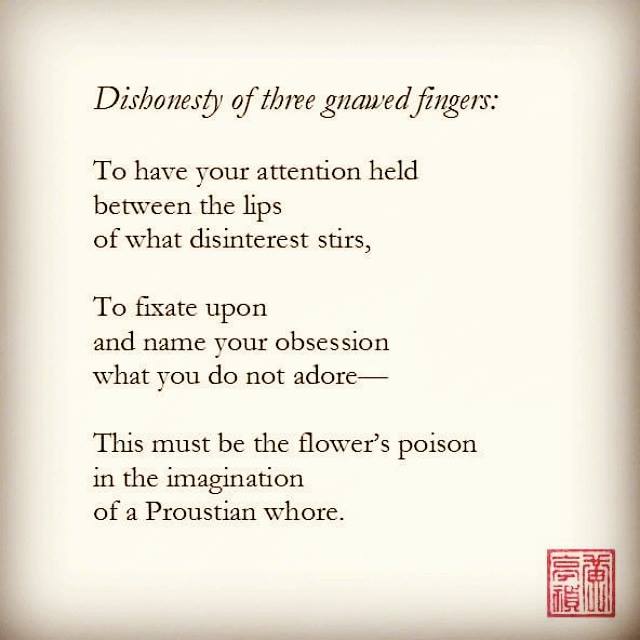
Dishonesty of three gnawed fingers:
To have your attention held
between the lips
of what disinterest stirs,
To fixate upon
and name your obsession
what you do not adore—
This must be the flower’s poison
in the imagination
of a Proustian whore.
 |
| I have always loved the mystery/horror genre. |
 |
| Roses, by David Sims for Visionaire |
 |
| image by John Mangila |
It’s quite an artform for one to stay looking golden on the outside, while feeling so profoundly rotten inside—not even sublimely or spectacularly ugly, merely this arid and lacklustre vapidness.
At some point it has got to start showing.
 | ||
Roses, by David Sims for Visionaire
|

Thursday, 28 May 2015
Scene 1: Lacrima / Scene 2: Du Fu Sings
Lacrima: Caruso-san
His pale blue skin, the voice of the flute,
Curtains rise for the Beautiful One’s play—
The role of the bleeding heart
is not to watch over that silver thread
woven callously, vicariously,
into the forgotten tapestry of the world,
but to shield with swan wings,
violently, majestically,
the other role of eternal unhappiness.
So that the arteries can ossify,
so that the obsolescence
of the bleeding heart and his eternal unhappiness
can encase themselves in a serene sleep
and seem obliviously irrelevant
to all but the Beautiful One.
+ + +
Du Fu Sings
Die yourself into a tree
Decant your breaths
A million times over
Would you walk through that door?
+ + +
Hypocrisy is a form of mental masturbation of the weak.

Wednesday, 27 May 2015
弔詭/弔念:Cioran and my fragmented poem (Chinese & English)
“By all evidence we are in the world to do nothing.” ~Emil Cioran
The ideal life for a muser and a paresseuse would be: to dream in the absence of dreams, and to dream of the absence of dreams, in other words, to dream nothing at all. The grandest thing to muse upon, would be those intricately-woven, beautifully-entangled illusions of all there is, i.e. nothingness—all of it, that is all there is. It’s just that long and inevitably mundane process (with perhaps some specks of high drama) one has to go through, could seem interminable.
+
Some more words from Emil Cioran to further tickle me:
“To live entirely without a goal! I have glimpsed this state, and have often attained it, without managing to remain there: I am too weak for such happiness.”
“I don’t understand why we must do things in this world, why we must have friends and aspirations, hopes and dreams. Wouldn’t it be better to retreat to a faraway corner of the world, where all its noise and complications would be heard no more? Then we could renounce culture and ambitions; we would lose everything and gain nothing; for what is there to be gained from this world?”
+
 |
| the Chinese original of this poem (titled 玉) was written in 1999, English translation/re-composition (re-titled Celadon) was created in 2011-2 |
蒼白,是血的原色與美學的逆鱗。
他舌尖的蓮消蝕一如
右頰的月光
聲音是時間與蛇的舞姿
交纏蜿蜒的連綴
而生存,歌詠著水波紊亂
殞落著無性之魅
猩紅,似卵與熱的曲線
錯誤的春花秋月
頹萎之靡交合在古印度的菱鏡
天人於是註定了五衰
水面下的墜
玉
 |
| Brett Whiteley, A Day at Bondi, 1984 // etching, black ink on white wove paper |
Thursday, 21 May 2015
Calling
... an Elgin marble from a waking dream
Would it not be a marvel
to find your calling—your niche—
to be suffering
(emptily, on empty)
draped over
a marvellous throne
where everyone feels
envy, breathlessly
(superficially)?
 |
| Dornröschen (Sleeping Beauty) by Louis Sussmann-Hellborn, 1878, via Alte Nationalgalerie, Berlin, Germany |
Wednesday, 20 May 2015
Diary fragments from Lady Emily’s lethargic life of yearning (i)
To live a life of truths saturated with ugliness and barren of beauty would be an unjustifiable lie.
+
An anonymous billet-doux arrived this morning. Were I not so intimately familiar with the author’s command of composing erotica-in-disguise, I would have assumed this Prince had fallen in lust with his object of affection after hearing my Goncourt comment. But such is not the case, given I am infinitely acquainted with his style:
Yes, the edge of that precipice offers the most pleasing panorama—a valley teeming with verdure, watered by a stream where the hart quenches his thirst with impunity, happily lapping with a tongue glistening in the warm sun of the temptress. Such places are quoted to us by voices that cry in the night, citing the authority of dreams on its riparian seat, of pillowed ivory, the cheek may rest.
Impunity, impunity only the bank punished with the hart’s burden as it takes its fill. A stream so beneficent one may lift it towards one’s lips rather than bend towards it. A stream whose source one may also devour. A stream whose waters teach lips eloquence. A stream that engenders others by virtue of the thirst it transfigures, whose moan is answerable to the plash of its puddles plied.
As I sat with the Prince many a blue moon ago, ruminating over the ridiculousness of life, I mused upon his poetic prowess in erotica, “You, dear sir, would make a handsome living writing these words.” To which he mischievously replied with a sparkle in his eye, “My tongue is best employed, when hearts rather than coins are cloyed.”
+
 |
| Antoon van Welie (Dutch, 1866–1956), Douleur, pastel, 1895 |
Goncourt tugged on a string in the womb of my heart tonight, and I say, “I have always derived inexplicable pleasure from singing to a virtuous nobleman, leading him in my hand to the edge of sin and leaving him there to live between the temptation and the fear of that sin.”
+
This afternoon, as languid and as annoyed as any other, Baron Gustave spoke to me about a petty—though entertaining—spectacle amongst the court eunuchs, whose comical adventures of trivialities delighted and somewhat intrigued me. On this person’s extraordinary literary competencies, Baron Gustave concluded, “He would have been an effective priest if he knew how to read anything but music.”
+
 |
| Archduchess Maria Isabella |
If death has a way of revealing the essence of things, as the poet Stéphane Mallarmé wrote of Edgar Allan Poe, then some of the essence that has been revealed these days is self-righteousness, bigotry, and above all, hypocrisy. The easy way out, the easy way out—always the easy way out. There is no intrinsic value to anything in this world—nor any intrinsic reality. The double-standard (of humanity) and pretentiousness are overwhelming. And then follows the avalanche of apathy.
Why are we such sheep that only blindly follow?
+
Have no fear of happiness—it exists as an illusion only. (This is not to say that happiness does not exist—it exists, like everything else in this apparent world, but as an illusion only.)
+
Thence began the odyssey of a little fool as he decided to write poems for the rest of his life in that faraway city named after a woman.
 |
| John William Waterhouse |
Thursday, 7 May 2015
They crave ecstasy, distilled and stilled with Orpheus’ music.
I see a lily on thy brow,
With anguish moist and fever-dew,
And on thy cheeks a fading rose
Fast withereth too.
I met a lady in the meads,
Full beautiful—a faery’s child,
Her hair was long, her foot was light,
And her eyes were wild.
I made a garland for her head,
And bracelets too, and fragrant zone;
She looked at me as she did love,
And made sweet moan
I set her on my pacing steed,
And nothing else saw all day long,
For sidelong would she bend, and sing
A faery’s song.
She found me roots of relish sweet,
And honey wild, and manna-dew,
And sure in language strange she said—
‘I love thee true’.
(from “La Belle Dame sans Merci: A Ballad,” by John Keats)
%2B-%2BVenus.%2BBerlin%2C%2BStaatliche%2BMuseen%2C%2BGem%C3%A4ldegalerie.jpg) |
| ❤ Workshop of Sandro Botticelli (Italian, 1444/45-1510). Venus, ca. late 1480s. Tempera on canvas, 158 x 68,5cm (62 3/16 x 26 15/16 in.). Photo Credit: Staatliche Museen Berlin, Gemäldegalerie / Photo © Jörg P. Anders |
Wednesday, 6 May 2015
as if hope and heart could meet, as if they might dance themselves out of the dark
The paper blushes, beads of sweat from that aftermath of love.
.JPG)
La poésie a inventé le monde, le monde, elle l'a oublié.
(Poetry invented the world; the world it then forgot.)
 |
| leg image via Mikio Watanabe |
 |
| The Meaning of Simplicity (translated by Rae Dalven), via Poetry Foundation |
 |
| 艾未未,白瓷花。(via @aiww Instagram) |
 |
| Ai Weiwei, “Blossom” (via @for_site & @george_fikry Instagram) |
 |
| image via @nicamille Instagram |
Monday, 13 April 2015
Between the mirage hue of Tiepolo Pink linings hides the tempting phantom of Proust’s invisible Venice
%2C%2BAbduction%2Bof%2BEuropa%2C%2BEuropa's%2Bhand%2Bdetail.jpg) |
| Jean François de Troy (French 1679 – 1752), The Abduction of Europa (detail of Europa's hand and cape), 1716, oil on canvas. National Gallery of Art, Washington, D.C. |
“It was the very evening on which Albertine had put on for the first time the indoor gown in gold and blue by Fortuny which, by reminding me of Venice, made me feel all the more strongly what I was sacrificing for her, who showed no corresponding gratitude towards me. If I had never seen Venice, I had dreamed of it incessantly since those Easter holidays which, when still a boy, I had been going to spend there, and earlier still, since the Titian prints and Giotto photographs which Swann had given me long ago at Combray. The Fortuny gown which Albertine was wearing that evening seemed to me the tempting phantom of that invisible Venice. It was overrun by Arab ornamentation, like Venice, like the Venetian palaces hidden like sultan’s wives behind a screen of perforated stone, like the bindings in the Ambrosian Library, like the columns from which the oriental birds that symbolised alternately life and death were repeated in the shimmering fabric, of an intense blue which, as my eyes drew nearer, turned into a malleable gold by those same mutations which, before an advancing gondola, change into gleaming metal the azure of the Grand Canal. And the sleeves were lined with a cherry pink which is so peculiarly Venetian that it is called Tiepolo pink.”
~Marcel Proust, À la recherche du temps perdu // In Search of Lost Time, Volume 5: The Captive, The Fugitive, translated by C. K. Scott Moncrieff & Terence Kilmartin, revised by D. J. Enright, p. 531.

 |
| Giovanni Battista Tiepolo (Italian, 1696 – 1770), details of An Allegory with Venus and Time, about 1754-8, oil on canvas. The National Gallery, London. |
*“Giovanni Battista Tiepolo: a thematic essay”on The Metropolitan Museum of Art's website
*“Proust & Fortuny”on A Hymn to Intellectual Beauty: Creative Minds and Fashion blog
Saturday, 11 April 2015
this living hand
This living hand, now warm and capable
Of earnest grasping, would, if it were cold
And in the icy silence of the tomb,
So haunt thy days and chill thy dreaming nights
That thou wouldst wish thine own heart dry of blood
So in my veins red life might stream again,
And thou be conscience-calm'd—see here it is—
I hold it towards you.
~John Keats (1795-1821), This Living Hand, 1819?


Friday, 6 February 2015
The music of memento mori:薔薇,無常。
花開花落:The reverie of mono no aware...
Breathing out their swansong. “A flower is perfect, when it is almost old.” An old favourite photograph I took of a rose bouquet I brought home. After having balleted through their beautiful efflorescence, these softly rouged petals dreamed their eventual, eternal slumber scattered upon my piano.
Poetry in the melodies of Eudaimonia’s sigh of bliss.

Monday, 2 February 2015
Was it a vision, or a waking dream? Fled is that music:—Do I wake or sleep?
I.
My heart aches, and a drowsy numbness painsMy sense, as though of hemlock I had drunk,
Or emptied some dull opiate to the drains
One minute past, and Lethe-wards had sunk:
’Tis not through envy of thy happy lot,
But being too happy in thine happiness,—
That thou, light-winged Dryad of the trees,
In some melodious plot
Of beechen green, and shadows numberless,
Singest of summer in full-throated ease.
II.
O, for a draught of vintage! that hath been
Cool’d a long age in the deep-delved earth,
Tasting of Flora and the country green,
Dance, and Provencal song, and sunburnt mirth!
O for a beaker full of the warm South,
Full of the true, the blushful Hippocrene,
With beaded bubbles winking at the brim,
And purple-stained mouth;
That I might drink, and leave the world unseen,
And with thee fade away into the forest dim:
III.
Fade far away, dissolve, and quite forget
What thou among the leaves hast never known,
The weariness, the fever, and the fret
Here, where men sit and hear each other groan;
Where palsy shakes a few, sad, last gray hairs,
Where youth grows pale, and spectre-thin, and dies;
Where but to think is to be full of sorrow
And leaden-eyed despairs,
Where Beauty cannot keep her lustrous eyes,
Or new Love pine at them beyond to-morrow.
IV.
Away! away! for I will fly to thee,
Not charioted by Bacchus and his pards,
But on the viewless wings of Poesy,
Though the dull brain perplexes and retards:
Already with thee! tender is the night,
And haply the Queen-Moon is on her throne,
Cluster’d around by all her starry Fays;
But here there is no light,
Save what from heaven is with the breezes blown
Through verdurous glooms and winding mossy ways.
V.
I cannot see what flowers are at my feet,
Nor what soft incense hangs upon the boughs,
But, in embalmed darkness, guess each sweet
Wherewith the seasonable month endows
The grass, the thicket, and the fruit-tree wild;
White hawthorn, and the pastoral eglantine;
Fast fading violets cover’d up in leaves;
And mid-May’s eldest child,
The coming musk-rose, full of dewy wine,
The murmurous haunt of flies on summer eves.
VI.
Darkling I listen; and, for many a time
I have been half in love with easeful Death,
Call’d him soft names in many a mused rhyme,
To take into the air my quiet breath;
Now more than ever seems it rich to die,
To cease upon the midnight with no pain,
While thou art pouring forth thy soul abroad
In such an ecstasy!
Still wouldst thou sing, and I have ears in vain—
To thy high requiem become a sod.
VII.
Thou wast not born for death, immortal Bird!
No hungry generations tread thee down;
The voice I hear this passing night was heard
In ancient days by emperor and clown:
Perhaps the self-same song that found a path
Through the sad heart of Ruth, when, sick for home,
She stood in tears amid the alien corn;
The same that oft-times hath
Charm’d magic casements, opening on the foam
Of perilous seas, in faery lands forlorn.
VIII.
Forlorn! the very word is like a bell
To toil me back from thee to my sole self!
Adieu! the fancy cannot cheat so well
As she is fam’d to do, deceiving elf.
Adieu! adieu! thy plaintive anthem fades
Past the near meadows, over the still stream,
Up the hill-side; and now ’tis buried deep
In the next valley-glades:
Was it a vision, or a waking dream?
Fled is that music:—Do I wake or sleep?
~John Keats, Ode to a Nightingale
 |
| 紫胸佛法僧 Lilac-breasted Roller (Coracias caudatus), image via. |
 |
| 紫胸佛法僧 Lilac-breasted Roller (Coracias caudatus), via. |
Friday, 30 January 2015
Saïat Nova’s Love Song
I sigh not, while thou art my soul! Fair one, thou art to me
A golden cup, with water filled of immortality.
I sit me down, that over me may fall thy shadow, sweet;
Thou art a gold-embroidered tent to shield me from the heat.
First hear my fault, and, if thou wilt, then slay this erring man;
Thou hast all power; to me thou art the Sultan and the Khan.
Thy waist is like a cypress-tree, sugar thy tongue, in sooth;
Thy lip is candy, and thy skin like Frankish satin smooth.
Thy teeth are pearls and diamonds, the gates of dulcet tones;
Thine eyes are gold-enamelled cups adorned with precious stones;
Thou art a rare and priceless gem, most wonderful to see;
A ruby rich of Mt. Bedakhsh, my love, thou art to me.
How can I bear this misery, unless my heart were stone?
My tears are blood because of thee, my reason is o’erthrown.
A young vine in the garden fresh thou art to me, my fair,
Enshrined in greenness, and set round with roses everywhere.
I, like the love-lorn nightingale, would hover over thee.
A landscape of delight and love, my queen, thou art to me!
Lo, I am drunken with thy love! I wake, but my heart sleeps.
The world is sated with the world; my heart its hunger keeps.
What shall I praise thee by, when naught is left on earth, save thee?
Thou art a deer, a Pegasus sprung from the fiery sea!
Speak but one word, to say thou art Saïat Nova’s* love,
And then what matters aught to me, in earth or heaven above?
Thy rays have filled the world; thou art a shield that fronts the sun.
Thou dost exhale the perfume sweet of clove and cinnamon,
Of violet, rose, and marjoram; to me, with love grown pale,
Thou art a red flower of the field, a lily of the vale!
___________________
*An Armenian minstrel often weaves his name into the last stanza of his song, in order that he may be known as its composer. The same peculiarity appears in the next poem.
~“Love Song” by Sayat-Nova, translated into English by Alice Stone Blackwell

 |
| Sergei Parajanov's muse, Georgian actress Sofiko Chiaureli, in his 1968 film The Colour of Pomegranates. |
Saturday, 6 December 2014
“All I ever asked of life was that it should pass me by without my even noticing it.”
—Fernando Pessoa, The Book of Disquiet
“Sometimes I sensed that the books I read in rapid succession had set up some sort of murmur among themselves, transforming my head into an orchestra pit where different musical instruments sounded out, and I would realize that I could endure this life because of these musicales going on in my head.”
—Orhan Pamuk, The New Life
 |
| fleuriste en Asie (via) |
Tuesday, 2 December 2014
Subscribe to:
Posts (Atom)

