Showing posts with label fashion. Show all posts

Monday, 13 April 2015

Between the mirage hue of Tiepolo Pink linings hides the tempting phantom of Proust’s invisible Venice


Jean François de Troy (French 1679 – 1752), The Abduction of Europa (detail of Europa's hand and cape), 1716, oil on canvas. National Gallery of Art, Washington, D.C.

“It was the very evening on which Albertine had put on for the first time the indoor gown in gold and blue by Fortuny which, by reminding me of Venice, made me feel all the more strongly what I was sacrificing for her, who showed no corresponding gratitude towards me. If I had never seen Venice, I had dreamed of it incessantly since those Easter holidays which, when still a boy, I had been going to spend there, and earlier still, since the Titian prints and Giotto photographs which Swann had given me long ago at Combray. The Fortuny gown which Albertine was wearing that evening seemed to me the tempting phantom of that invisible Venice. It was overrun by Arab ornamentation, like Venice, like the Venetian palaces hidden like sultan’s wives behind a screen of perforated stone, like the bindings in the Ambrosian Library, like the columns from which the oriental birds that symbolised alternately life and death were repeated in the shimmering fabric, of an intense blue which, as my eyes drew nearer, turned into a malleable gold by those same mutations which, before an advancing gondola, change into gleaming metal the azure of the Grand Canal. And the sleeves were lined with a cherry pink which is so peculiarly Venetian that it is called Tiepolo pink.”

~Marcel Proust, À la recherche du temps perdu // In Search of Lost Time, Volume 5: The Captive, The Fugitive, translated by C. K. Scott Moncrieff & Terence Kilmartin, revised by D. J. Enright, p. 531.


Giovanni Battista Tiepolo (Italian, 1696 – 1770), details of An Allegory with Venus and Time, about 1754-8, oil on canvas. The National Gallery, London. 

*“Giovanni Battista Tiepolo: a thematic essay”on The Metropolitan Museum of Art's website
*“Proust & Fortuny”on A Hymn to Intellectual Beauty: Creative Minds and Fashion blog


Thursday, 20 March 2014

月;影


Moon,

I think you would understand
my craft of writing, how it makes of me
your king and creature in this no-man's-land
of the moment;
the wide-eye, squint-eye vision that by turns
I loose upon your beauty, my soft palm
and callused fingers of an archer's hand;
and how my introspection bends me to
you, filling the mirror of this blank white sheet
with your circle of renewed virginity
that, by violating, I complete.

Moon, by Martin Edmunds, from Paris Review issue #121, winter 1991.


Hussein Chalayan, Sakoku 鎖國, spring/summer 2011

The book is an undefined object that we can discuss only in imprecise terms, an object forever buffeted by our fantasies and illusions. (...) 
Truth destined for others is less important than truthfulness to ourselves, something attainable only by those who free themselves from the obligation to seem cultivated, which tyrannizes us from within and prevents us from being ourselves. (...)
The paradox of reading is that the path toward ourselves passes through books, but that this must remain a passage. It is a traversal of books that a good reader engages in — a reader who knows that every book is the bearer of part of himself and can give him access to it, if only he has the wisdom not to end his journey there. (...) 
Encouraged from our school years onward to think of books as untouchable objects, we feel guilty at the very thought of subjecting them to transformation. It is necessary to lift these taboos to begin to truly listen to the infinitely mobile object that is a literary text. The text’s mobility is enhanced whenever it participates in a conversation or a written exchange, where it is animated by the subjectivity of each reader and his dialogue with others, and to genuinely listen to it implies developing a particular sensitivity to all the possibilities that the book takes on in such circumstances. (...)
All education should strive to help those receiving it to gain enough freedom in relation to works of art to themselves become writers and artists.

—Pierre Bayard, from How to Talk About Books You Haven't Read


Robert Mapplethorpe, Calla Lily, 1984, 1986 & 1985.

Sakoku 鎖國 ("chained country"), by Hussein Chalayan: decentered, wrapping in transition, shadow readings, imminence of water, haiku, floating body.

Sunday, 9 March 2014

Coracias Caudatus (lilac-breasted roller)


With a wide beautiful smile she walks back into his arms, the home of their hearts, like a black swan sweating out of the sweet tropics’ heat and humid scentsshe is dressed too warm for the sun and for his embrace. No one can understand the intense ivory in her voice, the aroused gem inside her body, save him, and his eyes: there is wind in the sky, there is gentleness that day in his usually inescapably fiery gaze.

Soon after they live their love she sleeps for two days. When she wakes, she covers herself with a white cashmere shawl. He wonders why she feels cold during a time when her body temperature should naturally be raised a few degrees. “I am always cold. I am a sickly child.” She says in a tone whose intention is to seduce more words from him. He strokes her face and says, “You look goodyou look rested.” All she can think about is his hands and his face and how much she longs for a cheesecake made with rose petals.

***

At night, in bed, her thoughts are racing, without logic, with no real purpose. She thinks he has fallen asleep next to her. “What is your emotional state after coming back to me?" Out of the blue he says. Stunned, and almost as if she was a child caught stealing candy from the glass jar, she stays silent for a while, breathing very quietly. “_________________”

She isn’t sure if he is convinced by her answer.


(To be continued...?)


Detail of a gown by Alexander McQueen, Spring 2007 Ready-to-Wear collection.

Hiroshi Sugimoto (Japanese, born 1948), Bust of Venus,
November 26, 1840, 2009. Gelatin silver print.
Image: 36 7/8 x 29 1/2 in. Framed: 48 7/8 x 41 1/2 in. © Hiroshi Sugimoto


Friday, 14 May 2010

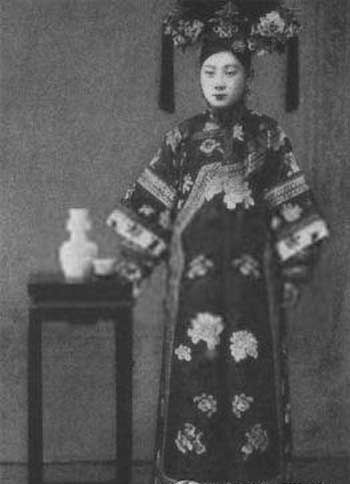
清末格格: Princesses of Late Qing China

In these old photos of Qing princesses and Imperial Court ladies, we can see the origin of qípáo 旗袍 (Wade-Giles ch'i-p'ao, also known as cheongsam):

When the Manchu ruled China during the Qing Dynasty, certain social strata emerged. Among them were the Banners (qí), mostly Manchu, who as a group were called Banner People (旗人 pinyin: qí rén). Manchu women typically wore a one-piece dress that came to be known as the qípáo (旗袍 or banner quilt). The qipao fitted loosely and hung straight down the body. Under the dynastic laws after 1636, all Han Chinese in the banner system were forced to wear a queue and dress in Manchurian qipao instead of traditional Han Chinese clothing (剃髮易服), under penalty of death. However after 1644, the Manchu relinquished this edict, allowing the main populace to continue to wear Hanfu, but gradually even they began to wear the qipao and changshan (長衫). In fact, only court officials were forbidden from wearing Ming court dress. In the following 300 years, the qipao became the adopted clothing of the Chinese, and was eventually tailored to suit the preferences of the population. Such was its popularity that the garment form survived the political turmoil of the 1911 Xinhai Revolution that toppled the Qing Dynasty.

朗貝勒府五格格愛新覺羅·恆馥

毓朗大格格愛新覺羅·恆慧,定郡王溥煦的大孫女。

末代皇后婉容的養母愛新覺羅·恆香(毓朗貝勒的二格格)。

愛新覺羅·恆香

The original qipao was wide and loose. It covered most of the woman's body, revealing only the head, hands, and the tips of the toes. The baggy nature of the clothing also served to conceal the figure of the wearer regardless of age. With time, though, the qipao was tailored to become more form fitting and revealing. The modern version, which is now recognised popularly in China as the "standard" qipao, was first developed in Shanghai after 1900, after the Qing Dynasty fell. People eagerly sought a more modernised style of dress and transformed the old qipao to suit their tastes. Slender and form fitting with a high cut, it contrasted sharply with the traditional qipao. However, it was high-class courtesans and socialites in the city that would make these redesigned tight fitting qipao popular at that time. In Shanghai it was first known as zansae or "long dress" (長衫 = Mandarin: chángshān, Shanghainese: zansae, Cantonese: chèuhngsàam), and it is this name that survives in English as the "cheongsam."

毓朗的女兒愛新覺羅·恆馨,她的女兒婉容為清朝的末代皇后。

愛新覺羅·恆馨,人稱四格格。

載灃長女大格格愛新覺羅·韞媖旗裝照,曾嫁給婉容的哥哥潤良為妻。

Ladies of Chinese Imperial Court in Qing Dynasty

The modernised version is noted for accentuating the figures of women, and as such was popular as a dress for high society. As Western fashion changed, the basic cheongsam design changed too, introducing high-necked sleeveless dresses, bell-like sleeves, and the black lace frothing at the hem of a ball gown. By the 1940s, cheongsam came in a wide variety of fabrics with an equal variety of accessories.

The 1949 Communist Revolution ended the cheongsam and other fashion in Shanghai, but the Shanghainese emigrants and refugees brought the fashion to Hong Kong where it has remained popular. Recently there has been a revival of the Shanghainese cheongsam in Shanghai and elsewhere in Mainland China; the Shanghainese style functions now mostly as a stylish party dress.

Text reference: Wikipedia - Cheongsam
Image source: 環球網 歷史影像室

肅親王的十七格格愛新覺羅·顯琦(又名金默玉),川島芳子的妹妹。

In Trashy Diva Watercolour Garden qipao inspired by a Mid-Century design, at the Chelsea Flower Show, London, summer 2007.

Thursday, 13 May 2010

霓裳羽衣

I have a special affection for traditional costumes and textiles of the Orient - Chinese qipao (旗袍), Japanese kimono (著物), Korean hanbok (韓袍), Indian sari, and the exquisite beauty of silks, embroidery, tie-dyed Ikat and Batik, Japanese sarasa (和更紗)... The list goes on and on. At the moment, I am particularly smitten over the stunning beauty of Hanbok.


一場春夢, "Spring Reverie," 
photography by Gun-Ho Lee for Vogue Korea.


*See also my other post on Kim Kyung Soo's photoshoot for Vogue Korea, "Full Moon Story."

Wednesday, 8 April 2009

Enchantment of the Full Moon


One of the very few "fashion" photoshoots which I love, from Vogue Korea October 2007 issue. The photographer is Kim Kyung Soo. This set of photos are quite a rare gem as the traditional Korean dress, Hanbok, is not depicted nearly as often in the west (and certainly the world of fashion/couture) as traditional Japanese kimono or Chinese qi-pao/cheongsam.

These beautiful and poetic visuals are also reminiscent of (for me at least) the lavishly gorgeous Korean film Untold Scandal, 스캔들 - 조선남녀상열지사, an adaptation of Stephen Frears's film Dangerous Liaisons.

See the complete set of Kim Kyung Soo's photoshoot for Vogue Korea, "Full Moon Story".


Monday, 6 April 2009

Think Pink!


I have this lovely video to share thanks (again) to my artistic friend Michiko.

Related Posts Plugin for WordPress, Blogger...