Thursday, 15 April 2010

Princesses of Ming 明


All exquisite jewellery below by Ming Design, London.


Qing Dynasty royal emerald snuff bottle, 19th Century. 
十九世紀 御用翡翠饕餮紋鼻煙壺 (image via 寒舍藝術中心)
Chinese Princess: Lantern Earrings
Pavé-set diamonds, black & green enamel, 18ct white and yellow gold


The Great Wave off Kanagawa (神奈川沖浪裏, Kanagawa Oki Nami Ura, lit. "Under a Wave off Kanagawa"), by Katsushika Hokusai (葛飾北斎).

Japanese Princess: Hokusai Water Earrings
Brilliant-cut diamonds, marquise-cut sapphires, blue enamel, 18ct white gold


Chinese Princess: Pagoda Ring
Onyx, square-cut emeralds, 18ct yellow gold


Tibetan Monastery (image via)
Tibetan Princess: Monastery Ring
Natural imperial jade, 18ct yellow gold


明 隆慶 甜白雙龍戲珠紋碗 (image via)
Chinese Princess: Dragon Chasing Flaming Pearl Earrings
200 pavé-set diamonds, rubies, Tahitian pearls, 18ct white gold


 傳統藝術 蝙蝠剪紙女紅 (image via)
Chinese Princess: Happiness Bat Earrings
108 pavé-set diamonds, white gold


Tibetan prayer wheels (image via)

Tibetan Princess: Open Ring
Pigeon's blood rubies, 18ct yellow gold


Kusho 1, by Shinichi Maruyama

Film still from Gion Bayashi 祇園囃子 (1953), directed by Kenji Mizoguchi

Japanese Princess: Tourmaline Ribbon Ring
7.64ct oval-cut Brazilian tourmaline, brilliant-cut diamonds, 18ct yellow gold


 Details of an Indian miniature painting (image via)
Indian Princess: Paisley Earrings
27cts emerald drops, 3.66cts brilliant-cut diamonds, 18ct white gold


an albinistic peacock
Japanese Princess: Swan Hoops
590 pavé-set diamonds, 18ct white gold


 Phoenix Hall (Amida Hall, or 鳳凰堂 hōō-dō), Byōdō-in (平等院), Uji City, Kyoto Prefecture, Japan {image via}

Tokyo Imperial Palace
Japanese Princess: Aquamarine Drops
30cts pear-shaped aqamarines, pavé-set diamonds, 18ct white gold


The Lake Palace, Udaipur, Rajasthan, India (image via)

Indian Princess: Lake Palace Cuff
Natural yellow brilliant-cut diamonds, 18ct yellow gold


Tuesday, 13 April 2010

Collected Quotes: Dietrich Fischer-Dieskau


By Dietrich Fischer-Dieskau

“Goethe always said that life must be like art somehow. It is for him only bearable if it is art. Otherwise it cannot be lived.”

“Art itself nourishes me as an inner vision. It has provided – and continues to provide – a possibility to lift oneself up to another level.”

“An intellectual singer is unthinkable, because a singer, like almost no other creature on earth, represents the proposition that there can be something approaching a unity of body, soul, and mind, at least in a symbolic fashion.”

“It is important to know that we are not the master of our will, that the intellect does not come first. First comes the will to expression – the drive to express oneself, to express artistic things. Only after that comes the critical distance that channels it.”

“In everything you do, you establish a kind of moral framework. You can never start too close to the basic principles.”

“I’m still very bound to the word, you know: committed to making the text more alive, more understood, closer to the audience than it may be on the printed page.”

“Performing music is more a question of serving, but painting is a dialogue from the start. You make only one stroke – and from that moment you are in discussion with your subject.”


On Dietrich Fischer-Dieskau

“You’re not a singer, you’re a bard!” (Paul Hindemith)

“He is a marvellous combination of intellectual power and wonderful vocal technique, and above all, he has a tremendous imagination.” (Gerald Moore)

“Fischer-Dieskau made a greater impression on the history of singing in the 20th century than any other performer.” (Hilary Finch)

“All of Fischer-Dieskau’s artwork is a mere accessory to his music making, only part of his adamant urge for ultimate self-expression. He scales artistic Matterhorns because they are there.”

For the Love of Josephine Foster...


It is only as an aesthetic phenomenon that existence and the world are eter­nally justified. (Nietzsche, The Birth of Tragedy)
+++

An die Musik, by Franz Schubert

Lyrics (original poem in German by Franz von Schober)

Du holde Kunst, in wieviel grauen Stunden,
Wo mich des Lebens wilder Kreis umstrickt,
Hast du mein Herz zu warmer Lieb' entzünden,
Hast mich in eine beßre Welt entrückt!

Oft hat ein Seufzer, deiner Harf' entflossen,
Ein süßer, heiliger Akkord von dir
Den Himmel beßrer Zeiten mir erschlossen,
Du holde Kunst, ich danke dir dafür!

Oh lovely Art, in how many grey hours,
When life's fierce orbit ensnared me,
Have you kindled my heart to warm love,
Carried me away into a better world!

How often has a sigh escaping from your harp,
A sweet, sacred chord of yours
Opened up for me the heaven of better times,
Oh lovely Art, for that I thank you!


Franz Schubert composed his lied "An die Musik" (German for "To Music") in March 1817 for solo voice and piano, with text from a poem by his friend Franz von Schober. In the Deutsch catalog of Schubert's works it is number 547, or D547. It was published in 1827 as Opus 88 No. 4 by Weigl.

A hymn to the art of music, it is one of the best-known songs by Schubert. Its greatness and popularity are generally attributed to its harmonic simplicity, sweeping melody, and a strong bass line that effectively underpins the vocal line.  (Source: Wikipedia)


American modern folk singer-songwriter Josephine Foster did a swooningly beautiful rendition of this song, which is included in her 2006 album A Wolf in Sheep's Clothing as the opening track (a live performance below). Be sure to click here and download the full album version - it is seriously too gorgeous to miss.


Dame Janet Baker sings Schubert's An die Musik, piano accompaniment by Murray Perahia, Covent Garden, London.


My absolute favourite baritone Dietrich Fischer-Dieskau's interpretation...


Wednesday, 31 March 2010

Mahler: Quartet for Piano & Strings in A minor/ Improvisation

My love for the spirituality and profundity in Mahler's musical landscapes warrants these videos an independent entry. Words are hushed and redundant when it comes to music that speaks as much as this. Does music not pale and silence all like a beautiful, magnificent, pure white avalanche?
Living as a global nomad at this moment, I take great solace in the accessibility of music in this digital age we live in.

Mahler caricatures (*image via Classical Iconoclast)


Monday, 1 March 2010

崑曲之桃花扇與牡丹亭:Kunqu-Peach Blossom Fan & Peony Pavilion


I have always been in love with Chinese opera, in particular kunqu (崑曲). The sweetness and tenderness of the actors’ voice, delicate hand gestures, dramatic facial expressions (especially those of the eyes), beautifully abstract movements, gorgeous costumes and classical stage designs etc. are but a few reasons that started my fascination with this enchanting and refined ancient artform. There has been a renaissance of kunqu opera in recent years, with artists from many different genres, writers, scholars and dramatists contributing their expertise into revitalising the art of classical Chinese theatre. Kunqu was listed as one of the Masterpieces of the Oral and Intangible Heritage of Humanity by UNESCO in 2001. Its melody or tune is one of the Four Great Characteristic Melodies in Chinese opera.

David and I went to see “The Peach Blossom Fan” at the Esplanade Theatre on Friday evening, performed by Jiangsu Kunqu Opera Theatre of China. It was an exquisite and dazzling performance, which I thoroughly enjoyed (equally as I adore the famous “Peony Pavilion” I saw in Taipei and London previously)—such a magnificent and harmonious marriage of music, theatre, songs, choreographed martial arts, dance, beautiful costumes, set designs, and splendid poetry/literature. “The Peach Blossom Fan” is a profoundly stunning, mesmerising dramatic piece with an Advaita Vedantic or Taoist, highly philosophical ending.


孔尚任《桃花扇》:Peach Blossom Fan by Kong Shangren


The Peach Blossom Fan is the landmark of the Chinese ancient legends. Tian Qinxin, Director of the Kunqu Opera—The Peach Blossom Fan (1699)—has invited the world-renowned artists to present an immortal masterpiece that will be passed from generation to generation.

The stage design for the play highlights simplicity and smart space: the stage contains smaller stages, the cloisters on both sides are painted with the painting works of the Ming Dynasty—The Map of the Prosperous Southern Capital—a masterpiece comparable to Life along the Bian River at the Pure Brightness Festival, and the mirror floor clearly reflects the human figures to render the effect of the shining waves.

The stage will also present rare treasures: Almost 200 sets of performing costumes that are all manually embroidered; the music score that will be sung again by the people today; the fan inscribed by Yu Zhenfei, the Kunqu Opera master; the headwear passed down from the ancestors of the famous masters, and the Ming Dynasty furniture.

Shi Xiaomei, Hu Jinfang, Huang Xiaowu and Ke Jun, known as four “
Plum Blossoms, will show up on the same stage to give a classical performance by three generations of Kunqu Opera actors.


Synopsis:

Using a peach blossom fan as the plot, the play expresses the emotion of rise and fall through the emotion of departure and reunification by elaborately combining the love story between Hou Fangyu, a famous scholar of Fushe, and Li Xiangjun, a famous prostitute in the Qinhuai River Region, with the political decay of the Southern Ming Dynasty. The play invites deep thinking and review.

Hou Fangyu got to know Li Xiangjun in a Nanjing brothel, and got engaged with each other. Ruan Dacheng, a remnant of the eunuch party, sent trousseaux to Li Xiangjun in private to buy Hou Fangyu after knowing the hero was financially tight. Li Xiangjun saw through the plot of Ruan Dacheng, and insisted on returning the trousseaux. Later, Ruan Dacheng brought a false charge against Hou Fangyu, saying Hou was collaborating with Zuo Liangyu to betray the court, and Hou was forced to escape Nanjing.


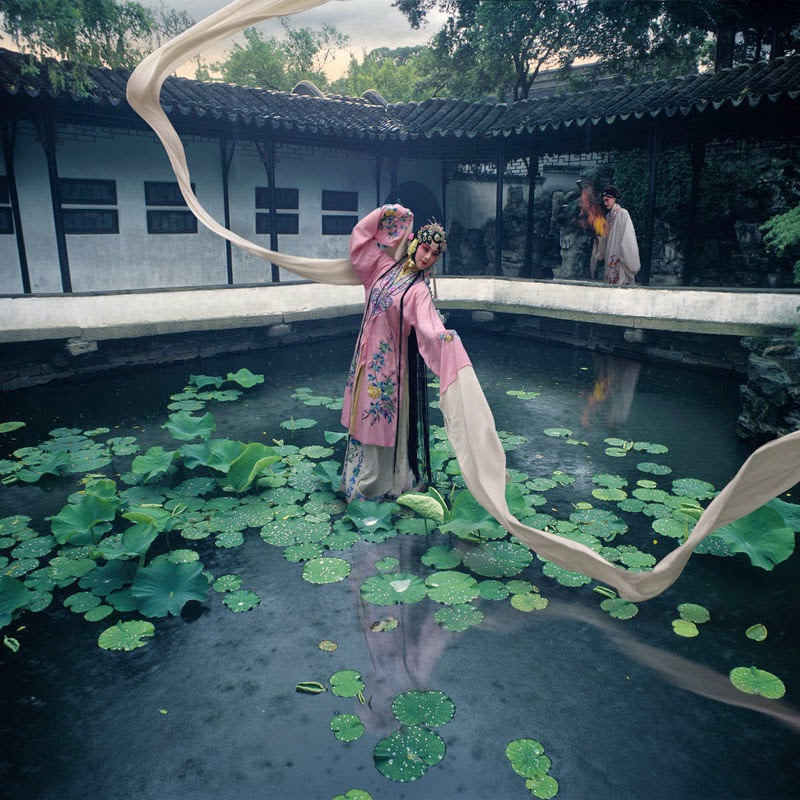
馮方宇《梅雨,踏荷》2007; 江蘇省蘇州崑劇院 *image via

After Chongzhen, the last emperor of the Ming Dynasty, hanged himself, Ma Shiying and Ruan Dacheng were in power again by supporting Prince Fu. They forced Li Xiangjun to diverse Hou Fangyu and marry Tian Yang, a follower. Li Xiangjun preferred to die rather than yield, and committed a suicide, with her blood sprayed on a fan, on which a love poem was inscribed. Yang Longyou, a friend of Hou and Li, painted the blood spots on the fan into peach blossoms on bent branches, and named it “The Peach Blossom Fan.

The Qing troops marched southwards, defeated Shi Kefa, a general of the Southern Ming Dynasty, and overthrew the Southern Ming Dynasty.

Hou and Li met each other again after ups and downs. However, where would be their end after the country was destroyed.

A Taoist surnamed Zhang on the Qixia Mountain enlightened them, saying “
The Peach Blossom Fan was broken. Then, Hou and Li then became the Taoist worshipers.

(*Via: National Centre for the Performing Arts, China.)


湯顯祖《牡丹亭》:Peony Pavilion by Tang Xianzu


The Peony Pavilion (simplified Chinese: 牡丹亭; traditional Chinese: 牡丹亭; pinyin: mǔdāntíng) is a play written by Tang Xianzu in the Ming Dynasty and first performed in 1598 at the Pavilion of Prince Teng. One of Tang’s “Four Dreams, it has traditionally been performed as a Kunqu (昆曲/崑曲) opera, but Chuan (川) and Gan (赣/贛) opera versions also exist. It is by far the most popular play of the Ming Dynasty, and is the primary showcase of the guimendan (闺门旦/閨門旦) role type. All Kun theatre troupes include it in their repertoire. Recent adaptations have sought to inject new life into one of China’s best-loved classical operas, though such efforts have met with opposition from the Kun opera traditionalists.


Synopsis:

The performance tradition has focused on the love story between Du Liniang (杜丽娘/杜麗娘) and Liu Mengmei (柳梦梅/柳夢梅), but its original text (standard translation: Cyril Birch) also contains subplots pertaining to the falling Song Dynasty’s defense against the aggression of the Jin Dynasty.

It is the last days of the Southern Song Dynasty. On a fine Spring day, her maid persuades Du Liniang, the sixteen-year-old daughter of an important official, Du Bao, to abandon her studies and take a walk in the garden, where she falls asleep. In Du Liniang’s dream she encounters a young scholar, identified later in the play as Liu Mengmei, whom in real life she has never met. Liu’s bold advances starts off a flaming romance between the two and it flourishes rapidly. Du Liniang’
s dream is interrupted by a flower petal falling on her (according to her soliloquy recounting the incident in a later act: Reflection on the lost dream. However, she was apparently awoken by her mother according to the script itself). Du Liniang, however, is since preoccupied with the intense oneiric affair and her lovesickness quickly consumes her. Unable to recover from her fixation, Du Liniang wastes away and dies.

The president of the underworld adjudicates that a marriage between Du Liniang and Liu Mengmei is predestined and Du Liniang ought to return to the earthly world. Du Liniang appears to Liu Mengmei in his dreams who now inhabits the same garden where Du Liniang had her fatal dream. Once recognising that Du Bao’
s deceased daughter is the lady who appears in his dreams, Liu agrees to exhume her upon her request and Du Liniang is brought back to life. Liu visits Du Bao and informs him of his daughters newly resurrection. However, Liu is met with disbelief and imprisoned for being a grave robber and an impostor. The ending of the play follows the formula of many Chinese comedies. Liu Mengmei narrowly escapes death by torture thanks to the arrival of the results of the imperial examination in which Liu has topped the list. The emperor pardons all.

(This is only a broad outline of the plot of an opera which typically runs for 20 hours.)


About Kunqu:

Kunqu (崑曲; pinyin: Kūnqǔ; Wade-Giles: k’un-chü), also known as Kunju, Kun opera or Kunqu Opera, is one of the oldest extant forms of Chinese opera. It evolved from the Kunshan melody, and dominated Chinese theatre from the 16th to the 18th centuries. Kunqu originated in the Wu cultural area.

Kunqu boasts a 600-year history and is known as the “teacher”
 or mother of a hundred operas, because of its influence on other Chinese theatre forms, including Jingju (Peking Opera). Its emergence ushered in the second Golden Era of Chinese drama, but by the early twentieth century it had nearly disappeared, which was only exacerbated by deliberate attempts to suppress it during the Cultural Revolution.

One of the major literary forms of the Ming and Qing dynasties was chuanqi drama, originating from the South. Chuanqi, an old form of dramatic opera, originates from the nanxi in late 14th century before the kunqu opera arises. However, in late 16 century, kunqu opera starts to dominate large part of Chinese drama. Plays that continue to be famous today, including The Peony Pavilion and The Peach Blossom Fan, were originally written for the Kunqu stage. In addition, many classical Chinese novels and stories, such as Romance of the Three Kingdoms, Water Margin and Journey to the West were adapted very early into dramatic pieces.

A Kunqu performer’
s portrayal of Hu SanniangToday, Kunqu is performed professionally in seven Mainland Chinese cities: Beijing (Northern Kunqu Theatre), Shanghai (Shanghai Kunqu Theatre), Suzhou (Suzhou Kunqu Theatre), Nanjing (Jiangsu Province Kunqu Theatre), Chenzhou (Hunan Kunqu Theatre), Yongjia County/Wenzhou (Yongjia Kunqu Theatre) and Hangzhou (Zhejiang Province Kunqu Theatre), as well as in Taipei. Non-professional opera societies are active in many other cities in China and abroad, and opera companies occasionally tour.

(*Via: wikipedia. Read more in-depth information about kunqu in “What is Kunqu Theatre?”)


Viennese Romance

I cannot stop reminiscing about Vienna and all of its beauty after watching the 2010 New Year's Concert video... For me, Vienna is like the jewel on an exquisite crown - perfectly elegant, and as the Chinese adage goes, "paints the eyes of the dragon."

I have combined these gorgeous short clips from Vienna's New Year Concerts with some lovely paintings which I find to be emanating the same fragrance and aura.


Franz Xavier Winterhalter, L'Impératrice Eugénie et ses dames de compagnies (The Empress Eugénie Surrounded by Her Ladies in Waiting), 1855, Château de Compiègne. Taking its inspiration from 18th-century bucolic scenes, this monumental composition sets the sovereign and her entourage against the backdrop of a shady clearing in a forest. However, the composition is very artificial and formal. The empress, slightly to the left of center, is encircled by and dominates the group. {via Wikipedia}

Franz Xavier Winterhalter, Elisabeth of Bavaria, Empress of Austria, with Diamond Stars on Her Hair, 1865, Hofburg, Vienna.

Gustav Klimt, Portrait of Mada Primavesi, 1912.


(*All paintings below by Edgar Degas)


Related Posts Plugin for WordPress, Blogger...